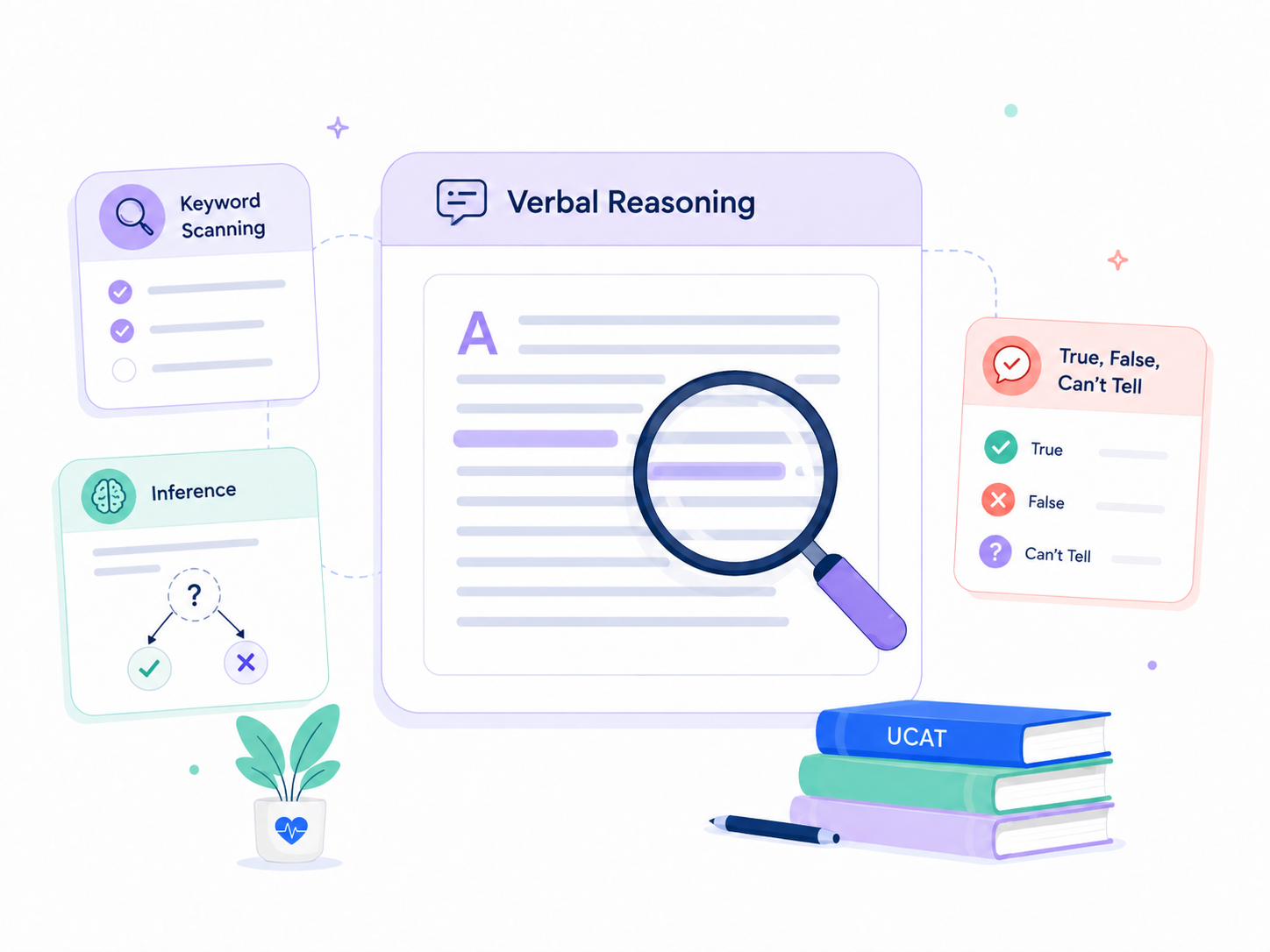
Verbal Reasoning can feel brutal when you first start. You open a passage, glance at the timer and suddenly every sentence seems longer than it should be. The key thing to remember is that UCAT Verbal Reasoning is not about reading beautifully. It is about reading efficiently.
The first habit to build is purposeful reading. You are not reading the passage the way you would read a novel or an article for fun. You are reading to find useful information. That means you should pay extra attention to names, dates, comparisons, opinions, cause-and-effect statements and any words that sound definite, such as “always”, “never”, “all” or “only”.
One of the biggest myths about Verbal Reasoning is that fast readers automatically do well. In reality, speed only helps if you are still taking in the right details. Many students read quickly but carelessly, then lose time because they have to go back and search again.
A better method is to scan with intent. Look for the shape of the passage. Notice where certain topics or people are mentioned. Then, when the question asks about something specific, you already have a rough map in your head.
Another important skill is staying inside the passage. This sounds obvious, but it catches students out all the time. If the passage says one thing and your real-world knowledge says something else, you must still answer based on the passage. The UCAT is not testing whether you know outside facts. It is testing whether you can use the evidence provided.
You also need to get comfortable with answer elimination. In Verbal Reasoning, wrong answers are often wrong for a reason. They may be too strong, too broad, slightly inaccurate or based on a tiny detail taken out of context. If an answer uses strong language like “all”, “only” or “must”, be careful. Those words raise the standard of proof.
When students struggle with timing, they often ask whether they should read the question first or the passage first. There is no single perfect answer for every student, but many people do well by glancing at the question first so they know what to look for. That said, you still need enough understanding of the passage to avoid being dragged into the wrong sentence.
Another good tip is to avoid getting stuck. If a question is taking too long, move on. One awkward question should not eat the time you need for several others. The UCAT rewards students who can keep the bigger picture in mind.
Practice also matters, but the right kind of practice matters most. Do not just do endless sets mindlessly. Review why you got things wrong. Were you rushing? Assuming? Missing a keyword? Misunderstanding the question stem? That is where real improvement comes from.
To improve Verbal Reasoning, focus on these habits:
- scan for key information
- use the passage, not outside knowledge
- be careful with extreme wording
- eliminate weak options
- manage your time sensibly
- review your mistakes honestly
Verbal Reasoning usually gets better when students stop trying to read everything perfectly and start learning how to read strategically. That is the shift you want to make.