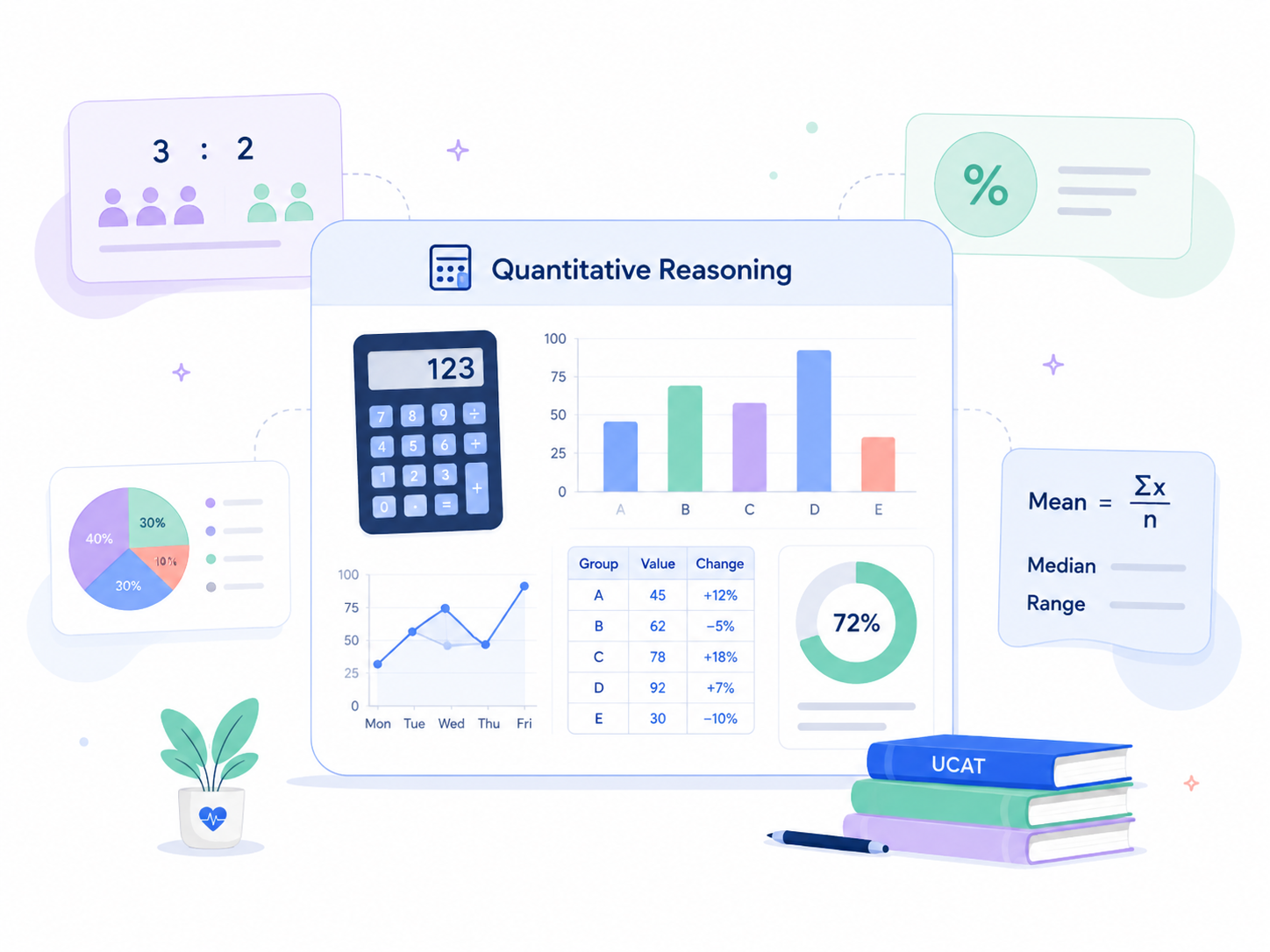
Quantitative Reasoning is the section that makes many students nervous, even when the maths itself is not especially advanced. That is because the real challenge is not just doing calculations. It is doing them quickly, accurately and calmly under pressure.
The first thing to remember is that UCAT Quantitative Reasoning mostly uses school-level maths. You are likely to see percentages, ratios, averages, proportions, currency conversion, speed and simple data interpretation. The difficulty comes from the speed and the amount of information in the question.
A strong starting point is becoming comfortable reading tables and charts quickly. Sometimes the maths is fine, but students lose time because they are hunting around the table trying to find the right number. Practise spotting the exact row, column or label you need before you begin calculating.
Another helpful skill is deciding when to calculate exactly and when to estimate. If the answer options are far apart, a rough estimate may be enough. That can save valuable time. On the other hand, if the answer choices are close together, you may need a more accurate calculation.
Percentages and ratios are especially common, so they are worth practising until they feel natural. If you hesitate every time you see a percentage increase or a ratio split, the time pressure builds quickly.
It also helps to stay neat. Students sometimes make QR harder than it needs to be because they try to juggle too many numbers at once. Writing down one or two clear steps can reduce silly mistakes.
You should also avoid emotional spirals. Many students see a long data question and immediately think, “I am terrible at this.” That thought does not help. Instead, break the question down. What is it actually asking for? What numbers matter? What can be ignored?
The onscreen calculator can be useful, but it is not a magic fix. If a sum is simple enough to do mentally, doing it mentally may be quicker. Save the calculator for when it genuinely helps.
To improve in Quantitative Reasoning, work on these habits:
- read the question carefully before calculating
- find the right data first
- practise percentages and ratios regularly
- estimate when appropriate
- use the calculator sensibly
- keep your working calm and tidy
The more familiar you become with the patterns in QR, the less scary it feels. Over time, you start to notice that many questions are testing the same small set of maths skills in different wrappers.
That is good news, because basic skills can be trained. You do not need to become a maths prodigy. You need to become quick, clear and steady.