Starting UCAT revision can feel strangely difficult. It is not always because the work itself is too hard. Often, it is because there are so many possible things to do that you do not know where to begin. When that happens, students either procrastinate or jump around randomly from one resource to another.
A much better approach is to keep the first stage simple.
Step one is understanding the test. Before you do large amounts of question practice, make sure you know the four sections and what each one is testing. If you understand the basic shape of the exam, everything else becomes less confusing.
Step two is doing a short baseline check. Try a small number of questions from each section. Do not worry about your score yet. The point is not to prove how clever you are. The point is to see what feels comfortable and what feels difficult.
Some students discover that Verbal Reasoning feels hardest because of the timing. Others find Decision Making strange at first because the logic question types are unfamiliar. Some panic at Quantitative Reasoning because they see charts and numbers and assume they are bad at maths. A few are surprised by Situational Judgement because it seems simple until the answer options start looking very similar.
This early diagnosis matters because strong UCAT revision is targeted. If you already know which areas need the most attention, you can spend your time more wisely.
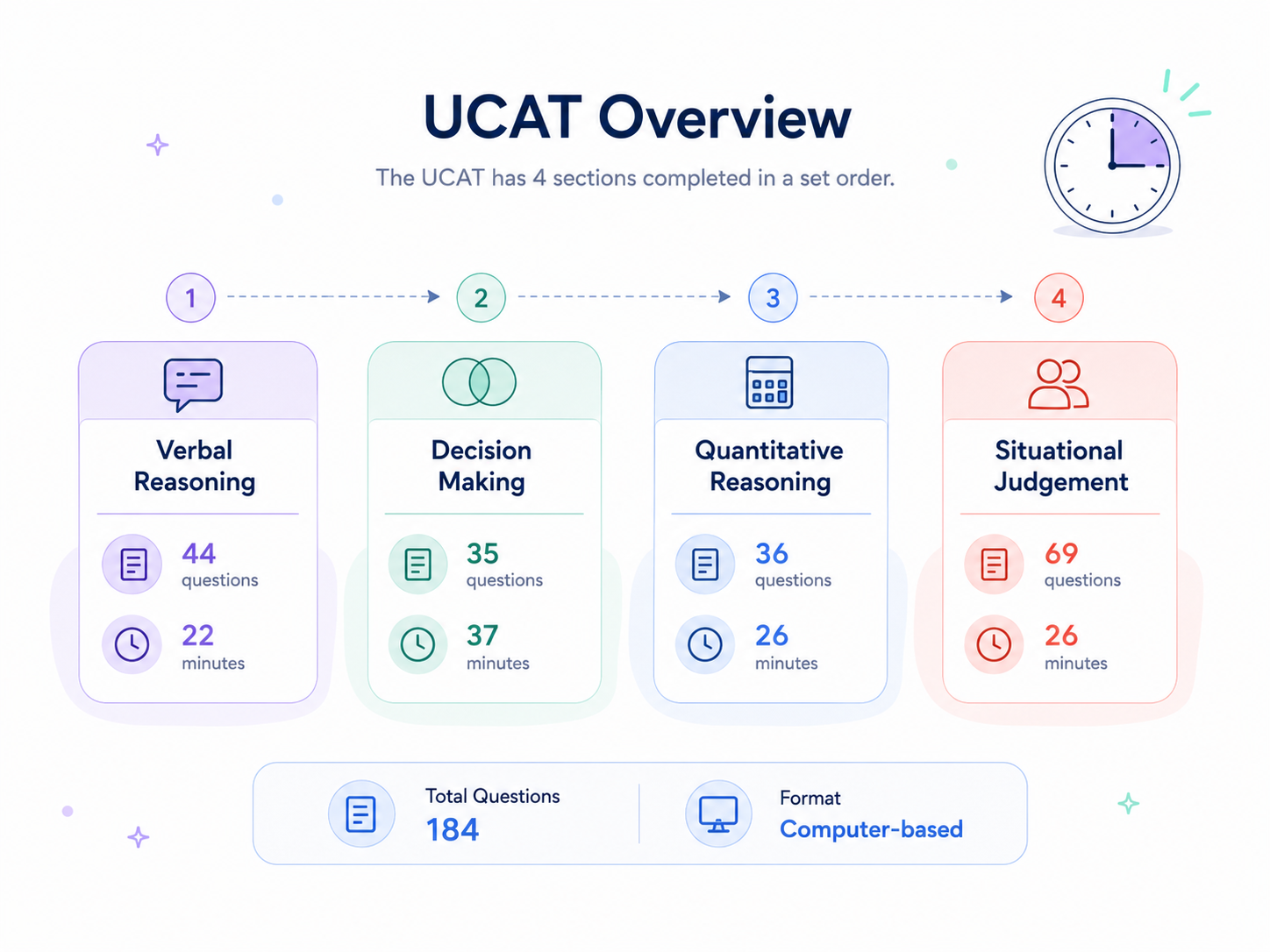
The Four UCAT Sections
Step three is building a realistic routine. This is where many students go wrong. They make a huge, dramatic revision timetable filled with daily three-hour sessions, then give up within a week. A better plan is one you can actually stick to. Even short, regular sessions can be powerful if they are consistent.
For example, you might begin with three or four focused sessions a week. One session could be Verbal Reasoning, one could be Quantitative Reasoning, one could be Decision Making, and one could be review or mixed practice. Situational Judgement can be slotted in regularly as well, especially once you start learning the core principles.
Step four is reviewing properly. This matters just as much as answering questions. If you get a question wrong and simply move on, you waste a lot of the value of practice. Instead, ask yourself why you got it wrong. Did you misread the question? Use the wrong method? Rush? Guess? Run out of time? Miss a key detail?
That kind of reflection helps you improve much faster.

Putting It Into Practice
Step five is tracking progress. You do not need an overly complicated spreadsheet if that is not your style, but you do need some way to notice patterns. Are you always losing marks on True, False, Can’t Tell questions? Are you slow on ratios? Do probability questions throw you off? Are you picking answers in Situational Judgement that sound kind but are not actually the most appropriate?
Once you can see the patterns, you can start fixing them.
Another helpful mindset shift is this: you do not need to feel ready before you start. Many students delay practice because they think they should study more theory first. In reality, the UCAT is best learned by doing. A question can teach you a lot, especially if you review it carefully afterwards.
You also do not need to compare yourself to other people. Some students begin with stronger scores because the test naturally suits them. Others improve through methodical work. The only comparison that really matters is whether you are getting better over time.
If you want a calm, strong start, keep these goals in mind:
- understand the exam
- try each section
- identify weak spots
- build a routine
- review mistakes
- improve step by step
That is how most good UCAT preparation begins. It is not glamorous, but it works.
If you are just getting started today, your job is not to master everything. Your job is simply to begin well.