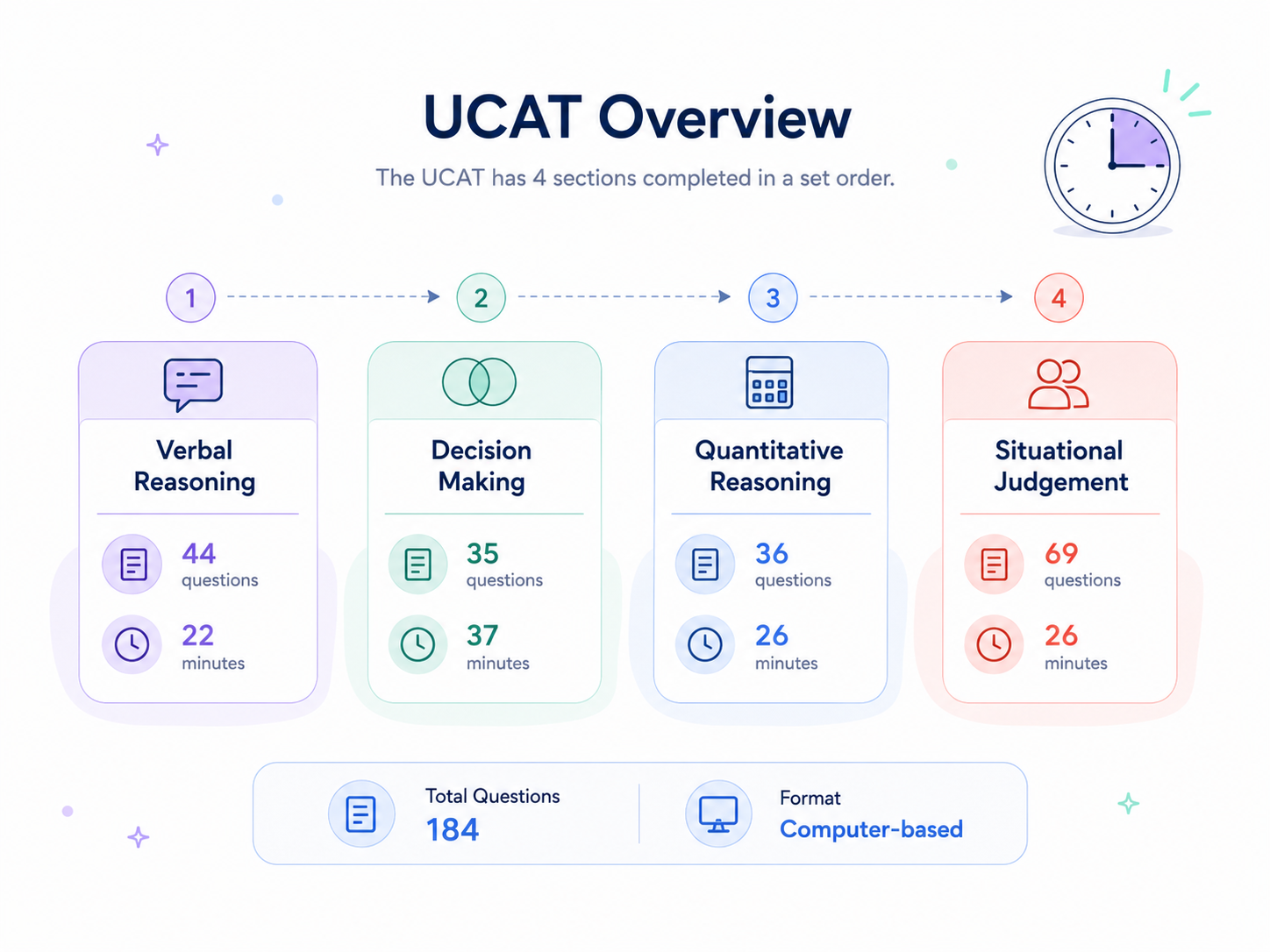
Improving UCAT timing does not mean moving your eyes and hands faster. It means wasting less time.
That distinction matters.
Students often respond to time pressure by rushing. They skim too aggressively, calculate carelessly and click answers before they have properly understood the question. Their speed improves, but their accuracy drops.
A better approach is to become more efficient.
Verbal Reasoning
efficiency might mean finding the relevant part of the passage quickly instead of rereading the whole text.
Decision Making
it might mean drawing a simple diagram instead of trying to hold five conditions in your head.
Quantitative Reasoning
it might mean estimating when the answer options are widely spaced.
Situational Judgement
it might mean identifying the core principle of the scenario before reading every option in detail.
Timing improves when your methods improve.

Building Your Plan
You should also practise moving on. One difficult question can destroy an otherwise good section if you spend too long fighting with it. The UCAT rewards students who protect their time.
Another useful strategy is reviewing your slow questions. Most students only review incorrect answers, but slow correct answers matter too. If a question took you three times longer than it should have, there is probably a better method.
Track where time disappears. Is it long passages? Calculator use? Logic puzzles? Rechecking? Once you know the problem, you can train it directly.
You can also build speed by repeating familiar skills until they become automatic. Percentages, ratios, common logic patterns and passage-scanning habits all become faster with repetition.
The goal is calm speed. You want to feel like you are moving with purpose, not scrambling.
If you are getting faster but your score is collapsing, you are not improving your timing. You are just rushing.