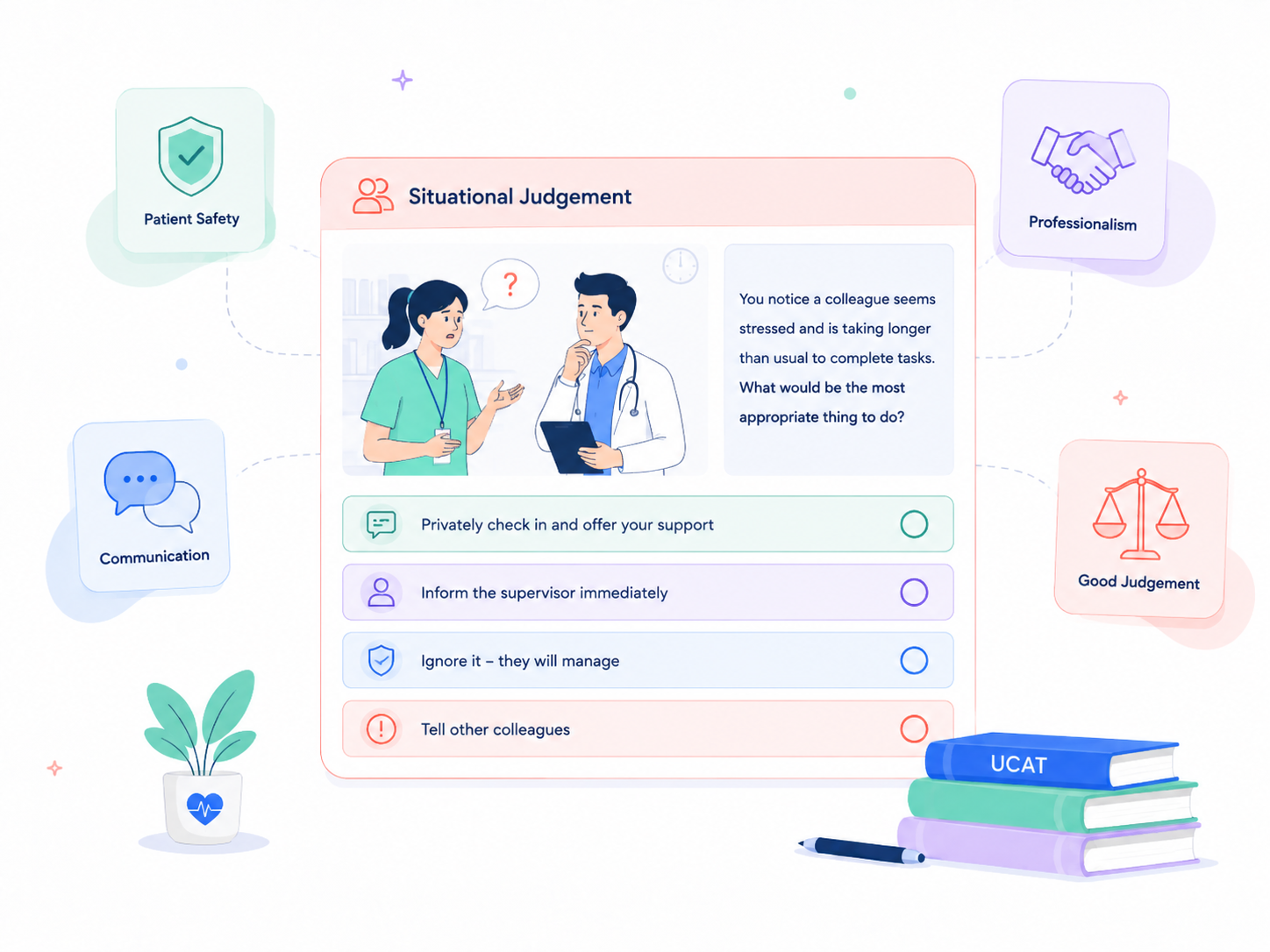
Situational Judgement can be one of the strangest sections in the UCAT because it feels less concrete than the others. There is no passage to scan and no table to calculate from. Instead, you are asked to judge situations and decide what is appropriate, important or sensible.
The good news is that this section is not random. It is built around clear principles.
In general, good answers in Situational Judgement protect safety, show honesty, respect confidentiality, recognise limits, value teamwork and respond in a proportionate way. That means the “best” answer is not always the friendliest sounding answer. It is the one that is safest, most sensible and most professional.
A common mistake is choosing an answer because it sounds kind, even though it is not the most appropriate. For example, keeping quiet to spare someone’s feelings might seem gentle, but if safety is at risk, that would not be the right priority.
Another common mistake is overreacting. Not every problem needs the most dramatic possible response. In some scenarios, the best first step is to speak to the person privately, check what is going on or seek support from the right senior person. Good judgement is not just about caring. It is also about responding in the right way.
When answering SJT questions, ask yourself:
- Is anyone at risk?
- What would be the safest action?
- Am I staying within my role and level of competence?
- Who should be involved?
- Is this response honest and respectful?
- Is the response proportionate to the problem?
Professionalism matters too. That includes being reliable, respecting others, communicating well and taking concerns seriously. If a scenario involves a mistake, the best answer usually includes honesty and appropriate action, not hiding the problem.
Confidentiality is another big theme. Sharing private information casually is usually inappropriate. That said, confidentiality is not absolute if there is a serious safety issue. In those cases, the correct response often involves seeking appropriate senior support.
If you want to improve in Situational Judgement, it helps to review not just which answer was correct, but why it was correct. Ask yourself what principle the question was really testing. Was it patient safety? Communication? Teamwork? Honesty? Boundaries?
Once you start spotting those deeper themes, the section begins to feel much more predictable.
Situational Judgement is not asking you to be perfect. It is asking you to think like a safe, sensible and responsible future healthcare student. If you keep those values at the centre of your thinking, your answers usually become much stronger.